What Size Chest Freezer Do You Need? A Cubic Feet Guide
The chest freezer size you need depends on your largest planned food load: start with 3.5 cu ft for light overflow, 5 to 7 cu ft for regular meal prep, and 10 to 17 cu ft for substantial bulk storage. Check the delivery route, ventilation gaps and open-lid space before choosing.
On this page (11 sections)
- What size chest freezer do I need for my food habits?
- How cubic feet translate into floor space
- Which freezer suits each size band?
- How should you measure the spot and delivery route?
- How much food fits in each cubic foot?
- Does a bigger chest freezer cost more to run?
- What changes when the freezer goes in a garage?
- How should you set up and care for the space you buy?
- When does an upright fit better than a chest?
- Which sizing mistakes should you avoid?
- Final decision: what size chest freezer do you need?
The chest freezer size you need depends on how much food you store at once, not just how many people live with you. Start with 3.5 cu ft for light overflow, 5 to 7 cu ft for regular meal prep, or 10 to 17 cu ft for substantial bulk storage.
A single person who freezes a harvest may need more room than a family that shops weekly. Count your biggest planned load, including food already frozen when the next grocery trip arrives.
The examples below show how each size fits a different buying habit. If the freezer will live outside a climate-controlled room, read our garage ready chest freezers guide before choosing.
What size chest freezer do I need for my food habits?
Choose capacity around your busiest storage week, with room to sort and retrieve food. Household size is a useful starting point, but shopping frequency and package size give you a better answer.
Use these bands to narrow your search rather than treating them as fixed household limits.
| Capacity | Start here if you need | Choose more room if |
|---|---|---|
| 3.5 cu ft | Extra meals and grocery overflow | You regularly bring home bulky boxes or meat orders |
| 5 cu ft | A modest stock of meals, meat and vegetables | New groceries arrive before older food gets used |
| 7 cu ft | Regular batch cooking and bulk groceries | You also store a harvest or large seasonal load |
| 10 cu ft | Several food categories in larger quantities | Your peak load includes large meat orders or substantial harvests |
| 17 cu ft | Extensive planned frozen storage | Check actual package fit before assuming even this is enough |
How to work out what size chest freezer you need
Make a list of what you expect to keep at the same time. Separate everyday food from occasional loads, such as holiday baking, garden produce or a large meat delivery.
Count packages in terms you recognize: meal containers, bread loaves, vegetable bags and meat portions. An exact pound estimate is less useful if half your space holds bulky packaging.
Include the food already in your refrigerator freezer if you plan to move it. If that compartment will remain your everyday storage, count only the overflow destined for the new chest.
Next, decide how you will organize those packages. Leave enough working room to lift a basket or move one group aside without unloading the whole freezer.
Size up for a known need, such as a regular batch-cooking schedule. Buying extra capacity for vague future plans can leave you with a large cabinet that occupies useful floor space.
How cubic feet translate into floor space
Cubic feet describes storage volume, while outside dimensions tell you how much room the cabinet occupies. The footprint is only the starting point because ventilation and access need additional space.
These measurements apply to the specific examples below. Other freezers in the same capacity band can have different shapes.
| Example | Capacity | Outside size (W x D x H) | Cabinet footprint |
|---|---|---|---|
| Midea convertible | 3.5 cu ft | 21.5 x 17.6 x 33.5 in | About 2.6 sq ft |
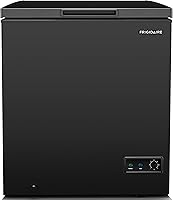
| Frigidaire EFRF5003 | 5 cu ft | 28 x 23 x 35 in | About 4.5 sq ft |
| Frigidaire EFRF7003 | 7 cu ft | 37 x 26 x 33 in | About 6.7 sq ft |
| BLACK+DECKER BCF1000E | 10 cu ft | 40.7 x 29.5 x 33.5 in | About 8.3 sq ft |
| Hamilton Beach HZ9471 | 17 cu ft | 70 x 28 x 35.04 in | About 13.6 sq ft |
The cabinet footprint excludes the maker's required gaps, space for you to stand and room to handle the lid. Tape the proposed cabinet outline on the floor, then mark those extra areas separately.
Outside measurements also cannot tell you whether a particular tray fits inside. Insulation and the compressor compartment reduce or change the usable interior shape.
Which freezer suits each size band?
Choose the model whose capacity and features match your routine. These 5 examples show the trade-offs from light overflow storage to a much larger food reserve.
Midea 3.5 cu ft: light overflow and changing storage needs
The Midea suits a small household that wants extra frozen storage without committing much floor space. Midea describes it as suitable for 1 to 3 people, but that assumes their food load fits.
Its fridge-to-freezer conversion helps if your storage needs change with the season. You choose one mode at a time, so it cannot hold frozen meals and fresh-food refrigeration at once.
A removable plastic basket gives small packages a place near the top. Adjustable legs help you level the cabinet during setup.
Choose it for modest overflow beside an existing refrigerator freezer. Skip it if your main goal is storing large cartons, a substantial meat order or weeks of batch-cooked meals.
Conversion changes the storage temperature, not the capacity. Our convertible vs standard chest freezers guide explains when that flexibility is worth choosing.
For alternatives with a similar footprint, see our best 3.5 cu ft chest freezers roundup.
Frigidaire 5 cu ft: a small household's regular reserve
The Frigidaire EFRF5003 suits a couple or small household that wants a steady reserve of groceries. It is a sensible step beyond occasional overflow when you have a clear plan for using the extra room.
The removable vinyl-coated wire basket can hold frequently used packages above the deeper stock. Its exterior defrost drain helps you manage meltwater during maintenance.
A power-on light makes the power status visible, but it does not confirm the food is cold enough. Use a separate freezer thermometer rather than reading the thermostat's numbered settings as degrees.
Choose it for manageable meal prep and grocery storage. Skip it if you already struggle to fit a regular bulk shop into a similar amount of space.
Frigidaire calls this model garage ready; confirm its approved ambient range before using it in an unheated or hot garage. Compare alternatives in our best 5 cu ft chest freezers roundup.
Frigidaire 7 cu ft: regular batch cooking and bulk groceries
The Frigidaire EFRF7003 suits households that keep several kinds of food in reserve. It gives you more scope to separate meals, meat, vegetables and bread without moving into the largest cabinets here.
The removable basket provides a top layer for smaller items, while larger packages can go below. An adjustable thermostat, power-on light and exterior defrost drain cover the basic controls and maintenance needs.
Choose it when bulk buying is part of your normal routine, rather than an occasional idea. A family of four can use this as a starting point, then adjust for its existing freezer space.
Skip it if your planned stock is mostly a few extra meals and vegetable bags. Also confirm the approved operating conditions before assigning this model to a garage.
Our best 7 cu ft chest freezers roundup compares more options in this middle size band.
BLACK+DECKER 10 cu ft: larger planned food loads indoors
The BLACK+DECKER BCF1000E suits buyers with a defined need for more storage in a kitchen or temperature-controlled basement. Choose it when a smaller chest would force you to stack too many unrelated foods together.
Its exterior mechanical control lets you adjust the setting without opening the lid. Power and compressor indicator lights show operating status, and the manual-defrost design includes an easy-access drain.
This model makes sense for regular large grocery runs or several rounds of batch cooking. Plan separate storage zones before loading it so the extra volume stays useful.
Skip it if the only available location is an unconditioned garage unless BLACK+DECKER confirms that location is suitable. The supported placement here is indoor, temperature-controlled storage.
If this is the capacity you need, our best large chest freezers roundup offers more comparisons.
Hamilton Beach 17 cu ft: extensive food reserves
The Hamilton Beach HZ9471 suits buyers who can name a substantial load they need to store. A large household, seasonal harvest or regular hunting and fishing supply can justify this much capacity.
The stay-open lid helps while you sort or load food. A removable wire basket, front-access defrost drain and adjustable leveling legs support everyday use and maintenance.
Choose it for an established storage habit, with an inventory system ready from the start. Its broad cabinet needs a dedicated location rather than a leftover gap beside other appliances.
Skip it if reaching into a chest is difficult or you rarely carry more than a small reserve. A bigger freezer cannot solve poor access, and food at the bottom still needs to be found.
Hamilton Beach calls it garage ready; confirm the approved ambient range for your location before installation.
How should you measure the spot and delivery route?
Measure the whole route and operating space, not just the empty floor. A freezer must pass through doorways, open fully and leave enough room for you to use it.
- Measure the narrowest doors, hallways and turns between delivery and installation.
- Compare those gaps with the cabinet dimensions, allowing for handles, hinges or packaging where relevant.
- Check the manual's ventilation clearances on all required sides.
- Measure overhead space for the fully open lid, including shelves, pipes and cabinet doors.
- Leave standing room to lift food and reach the bottom.
- Keep the controls, plug and defrost drain accessible.
An outline on the floor helps reveal conflicts with laundry baskets, parked vehicles or nearby doors. Try standing at the proposed front edge and bending toward the back before committing to the spot.
Plan for the freezer's loaded weight as well as the empty cabinet. Arrange suitable moving help, especially where stairs or tight turns complicate delivery.
If transport may require tilting, read can you lay a chest freezer on its side and follow the model's moving and restart instructions.
How much food fits in each cubic foot?
There is no single reliable food weight per cubic foot for every household. Dense meat packages, loose vegetable bags and ice cream cartons fill the same volume differently.
Do not plan a purchase around a promised meal count unless you know the container sizes. Tall tubs can leave gaps that flat portions would use, and oversized boxes can block access to smaller food.
Where food handling allows, portion it into meal-size packs and freeze bags flat before stacking them. Keep labels visible and avoid burying loose packets beneath heavy packages.
Measure unusually large items separately, such as a roasting tray or a bulk meat package. Total capacity does not guarantee an uninterrupted space of the right shape.
Baskets and bins use some volume but can prevent forgotten food. Our guide to how to organize a chest freezer explains how to divide the space into useful zones.
Does a bigger chest freezer cost more to run?
Compare annual energy use for the exact models, rather than guessing from capacity alone. Insulation, room temperature, lid openings and how the freezer operates all affect electricity use.
Watts measure power at a moment, while kilowatt-hours measure energy used over time. A wattage figure alone does not tell you the yearly cost because the compressor cycles.
Multiply annual kWh by your electricity rate to estimate annual running cost. Compare units using the same measure, ideally their EnergyGuide information.
ENERGY STAR freezer guidance explains energy considerations. Our guide to how many watts a deep freezer uses covers the difference between power draw and energy use.
What changes when the freezer goes in a garage?
Garage placement adds an ambient-temperature requirement, separate from capacity. First establish how hot and cold the space gets, then choose a suitable model in the size you need.
Midea gives its convertible an operating range of 0°F to 110°F in freezer mode and 38°F to 110°F in fridge mode. Those ranges describe the surrounding air, not the storage temperature inside.
Confirm the approved range for the garage-ready Frigidaire and Hamilton Beach examples. Do not assume another model shares the same limits because it has similar capacity or branding.
Keep the freezer sheltered from weather and away from places where vehicles or stored equipment could block access. Garage suitability does not guarantee suitability for outdoor exposure.
The USDA FSIS freezing guidance gives 0°F or below as the freezer storage target. For suitable options, see our best chest freezers for the garage roundup.
How should you set up and care for the space you buy?
Set up the freezer according to its manual and let it reach the proper temperature before loading food. Level the cabinet, keep ventilation gaps clear and use the specified electrical connection.
Check temperature with a separate thermometer. A power light shows that electricity is present, while a numbered thermostat dial does not directly show the temperature around your food.
Date packages and keep an inventory near the freezer. Put new food behind or below older food within each zone so your stock turns over.
Follow the manual's defrost guidance rather than letting frost consume useful room. Arrange temporary frozen storage first, then use our chest freezer defrosting guide to plan the job.
Keep the lid seal clean and check that bags do not obstruct closure. Avoid treating the lid as permanent storage, since clearing it for every meal makes the freezer harder to use.
When does an upright fit better than a chest?
Choose an upright if shelf access matters more than a broad storage well. It may suit a narrow floor area or a household that wants small packages visible without reaching down.
A chest suits buyers who want to arrange larger packages in an open compartment. Check your reach and lifting comfort before deciding that more chest capacity is the answer.
Our chest freezer vs upright freezer comparison covers access and layout. For terminology, see deep freezer vs regular freezer.
Which sizing mistakes should you avoid?
Avoid choosing capacity from household size alone. The useful question is what must fit at the same time and how you will retrieve it.
- Buying for an imagined bulk-buying habit instead of a planned food load.
- Counting existing freezer contents twice when they will stay in the refrigerator.
- Treating cabinet footprint as the full installation space.
- Forgetting that large boxes and trays need usable interior dimensions.
- Filling every gap so tightly that older food becomes hard to reach.
- Assuming a larger freezer automatically suits a garage.
- Choosing a chest you cannot comfortably reach into.
If your needs are modest, our best small chest freezers roundup can help narrow the search without jumping to a larger cabinet.
Final decision: what size chest freezer do you need?
Choose the smallest capacity that holds your peak planned load with usable access. Move up a band when you can name the extra food it will hold, rather than simply because more space is available.
- Choose the Midea for light overflow and the option to switch to fridge storage.
- Choose the Frigidaire 5 cu ft for a modest, regularly used food reserve.
- Choose the Frigidaire 7 cu ft for routine batch cooking and bulk groceries.
- Choose the BLACK+DECKER 10 cu ft for larger planned loads in a temperature-controlled room.
- Choose the Hamilton Beach 17 cu ft for extensive storage with a dedicated space and inventory plan.
Before ordering, match the cabinet to your taped floor outline and confirm lid clearance. If a garage is the destination, use best chest freezers for the garage to make operating temperature part of the final choice.
Frequently asked questions
What size chest freezer do I need for a family of four?
Start by comparing 5 and 7 cu ft models for a family of four; choose the smaller size for overflow beside a roomy refrigerator freezer, or the larger size for regular batch cooking and bulk groceries. Your largest planned food load matters more than household size alone.
Is a 3.5 cu ft chest freezer enough for one person?
A 3.5 cu ft chest freezer can suit one person who needs room for extra meals, vegetables and a modest meat supply; choose more space if you freeze a garden harvest or buy large meat orders. Midea describes its model as suitable for 1 to 3 people.
How many cubic feet do I need for a garage freezer?
Choose garage freezer capacity by your food load, then check whether the model supports your garage temperatures; a larger cabinet does not make a freezer suitable for heat or cold. Measure the floor, ventilation gaps, open-lid space and delivery route before settling on a size.
Does cubic feet tell me how much food fits?
Cubic feet describes storage volume, but it does not give an exact food weight or meal count; flat bags pack differently from bulky cartons, and baskets take space while improving access. Compare the largest packages you plan to store rather than relying on a universal pounds-per-cubic-foot rule.
Should I measure the outside or the inside of a chest freezer?
Check outside dimensions first to confirm the freezer can reach its spot and operate with the required clearances; then check usable interior measurements if you need to fit a large tray or meat package. Cabinet insulation, baskets and the compressor compartment affect the shape of the space inside.