8 Best Small Chest Freezers for Small Spaces (November 2026)
The best small chest freezers include the Kismile 3.2 cu ft Chest Freezer for everyday kitchen overflow, the Demuller 3.5 cu ft Chest Freezer for frequent temperature changes, and the Midea 3.5 cu ft Convertible Chest Freezer for changing storage needs.
On this page (13 sections)
- The best small chest freezers for different households
- Compare cabinet size before choosing capacity
- How these small chest freezers were compared
- Which capacity fits your grocery habits?
- Measure ventilation, lid space and the delivery route
- Organize small food before it disappears underneath
- Set the temperature by measurement, not the dial number
- Match garage placement to the room's temperature
- Plan delivery and first use before loading groceries
- Defrost and clean without damaging the cabinet
- Compare running costs without confusing watts and kWh
- Common mistakes that make a small freezer less useful
- Final decision: the best small chest freezer for your space
The best small chest freezer for most homes is the Kismile 3.2 cu ft, with two baskets that make everyday grocery overflow easier to sort. Choose the Midea if you need fridge mode or defined garage temperature limits, and consider the Frigidaire for larger meal-prep loads.
The right size depends more on your shopping habits than your household count. A person who freezes several weeks of meals may need more room than a couple buying frozen food a few days at a time.
Start with our cubic feet size guide if you're unsure about capacity. For an unheated or hot storage room, our complete guide to garage ready chest freezers explains the placement checks.
Our picks at a glance
-
1
 Best for everyday kitchen overflow
Kismile 3.2 cu ft Chest Freezer
8.5/10 our score
See it on Amazon -
2
 Best for frequent temperature changes
Demuller 3.5 cu ft Chest Freezer
8.4/10 our score
See it on Amazon -
3
 Best for changing storage needs
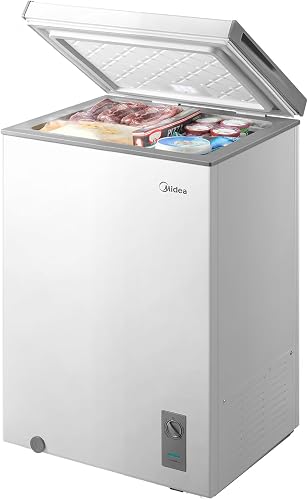
Midea 3.5 cu ft Convertible Chest Freezer
8.2/10 our score
See it on Amazon
- 4
 Check it
Frigidaire EFRF5003 5 cu ft Garage-Ready Chest Freezer
Best for batch cooking households - 5
 Check it
BLACK+DECKER 2.7 cu ft Compact Chest Freezer
Best for narrow kitchen corners - 6
 Check it
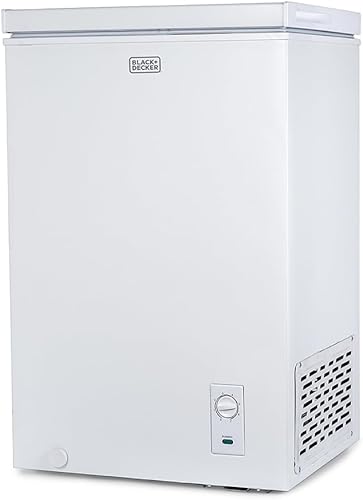
BLACK+DECKER 2 cu ft Compact Chest Freezer
Best for modest grocery overflow - 7
 Check it
Bodacious 3.5 cu ft Mini Deep Freezer
Best for low cabinet height - 8
 Check it
Bodacious 5 cu ft Ultra Quiet Deep Freezer
Best for fresh grocery loads
The best small chest freezers for different households
Kismile is the strongest everyday choice for organized indoor storage, while the other picks solve more specific space or food-storage needs. Choose by the job you need done before comparing extra features.
Kismile 3.2 cu ft Chest Freezer: Best for everyday kitchen overflow
- Two removable baskets
- Seven-level thermostat
- Lid stays open from 45 to 90 degrees
- Kismile says noise stays below 40 dB
Two sliding baskets help separate small packages from larger food below. The lid stays open while you load groceries or check your stock.
Pros
- Two removable baskets
- Lid holds open for sorting
- Power and run indicator lights
Cons
- No confirmed garage operating range
- Requires at least 24 hours upright before first use
Kismile suits a kitchen where frozen vegetables, meal portions and small meat packs compete for space. Its two sliding baskets let you keep frequently used food near the top while leaving larger packages below.
The lid stays open from 45 to 90 degrees, which helps when you need both hands to sort groceries. Separate power and run lights let you check the unit's status without lifting the lid.
Its thermostat adjusts from 6.8 F to -7.6 F across seven settings. Use a thermometer to find the setting that maintains your storage target rather than assuming the middle position is right.
Kismile says noise stays below 40 dB, making this a candidate for a shared living area. Compressor sound can still be noticeable in a quiet room.
Buy it for regular indoor overflow, especially small packages that benefit from separate baskets. Skip it for an unconditioned garage unless Kismile confirms an operating range that fits your room.
Demuller 3.5 cu ft Chest Freezer: Best for frequent temperature changes
- Digital settings in 1 F steps
- Temperature range from -15 F to 41 F
- Two stainless steel baskets
- Side drains for manual defrost
Digital controls let you choose a temperature without translating a numbered dial. The display shows the selected setting, so use a separate thermometer to check food storage conditions.
Pros
- Temperature settings in 1 F steps
- Two stainless steel baskets
- Demuller says noise stays below 38 dB
Cons
- Display shows the setting, not measured temperature
- Controls require a 3-second hold before changes
Demuller suits buyers who prefer choosing a number rather than adjusting a numbered dial. Its electronic control offers settings in 1 F steps across a range of -15 F to 41 F.
The key distinction is that the display shows your selected setting, not the measured temperature inside. A separate thermometer remains useful, especially after loading groceries or changing the control.
Two stainless steel baskets help divide smaller items. The interior measures 16.5 x 12 x 24.1 inches, so compare bulky cartons and meal containers with those dimensions before choosing it.
Side drain holes also affect placement: leave access where you can collect defrost water. Demuller says operating noise stays below 38 dB.
Choose it if clear temperature settings matter more than a simple knob. Skip it if you expect the display to monitor actual food-storage conditions, or if your preferred containers need a wider interior.
Midea 3.5 cu ft Convertible Chest Freezer: Best for changing storage needs
- Freezer and fridge modes
- Removable plastic basket
- Adjustable leveling legs
- Interior LED light
Switch between frozen food storage and spare refrigerator space as your needs change. Midea gives separate room-temperature limits for each mode.
Pros
- Separate fridge and freezer modes
- Defined garage operating ranges
- Interior light helps locate food
Cons
- Cannot refrigerate and freeze food at the same time
- Mode changes require moving food that needs the previous temperature
Midea suits a household whose spare cold-storage needs change through the year. Use freezer mode for meal portions, then switch to fridge mode when chilled food needs the whole cabinet.
Its defined ambient limits make garage planning clearer: Midea gives 0 F to 110 F for freezer mode and 38 F to 110 F for fridge mode. Compare those limits with the room's seasonal extremes.
An interior LED light helps you find food, while adjustable legs help level the cabinet. The removable plastic basket gives smaller packages a place above larger food.
Midea also claims up to 48 hours of frozen storage after a power loss. Actual food temperature should guide decisions during an outage rather than the elapsed time alone.
Skip it if you need chilled drinks and frozen food in the same cabinet simultaneously. Read our Midea 3.5 cu ft convertible review and convertible vs standard chest freezers guide for more detail.
Frigidaire EFRF5003 5 cu ft Garage-Ready Chest Freezer: Best for batch cooking households
- Seven-setting thermostat
- Removable vinyl-coated wire basket
- Exterior defrost drain
- Aluminum interior liner
The larger cabinet suits households freezing several meals at once. Its broad footprint needs more planning than the narrower models here.
Pros
- More storage than the smaller picks
- Exterior drain for defrost water
- Power-on indicator light
Cons
- Largest footprint in this group
- Garage operating limits need confirmation
Frigidaire suits households that freeze several meals at once and have enough room for a wider cabinet. Its 5 cu ft capacity gives meal containers more space than the smaller picks.
The removable vinyl-coated wire basket can hold foods you reach for often. Larger bags and containers go below, where a simple food map helps prevent forgotten meals.
A front thermostat knob offers seven settings, and a power-on light shows that the unit has power. That light is not a temperature alarm, so it cannot confirm that food is cold enough.
The aluminum liner and exterior defrost drain are useful practical features. Plan a way to collect water without blocking access to the freezer.
Frigidaire calls this model garage ready, but confirm the ambient limits before choosing a hot or cold garage. Skip it if its wider cabinet crowds your walkway, and compare alternatives in our best 5 cu ft chest freezers roundup.
BLACK+DECKER 2.7 cu ft Compact Chest Freezer: Best for narrow kitchen corners
- Same footprint as the 2 cu ft model
- Seven-setting exterior dial
- Removable storage basket
- Manual defrost with drain
Choose this over the smaller BLACK+DECKER when floor space is fixed but extra height is available. It adds storage without widening the cabinet.
Pros
- More capacity on the smaller model's footprint
- Controls sit outside the cabinet
- BLACK+DECKER provides a 1-year limited warranty
Cons
- Taller than the 2 cu ft version
- Needs at least 4 inches of clearance around the unit
BLACK+DECKER's 2.7 cu ft model suits buyers who have a narrow floor space but can accommodate a taller freezer. It shares the smaller BLACK+DECKER's width and depth while adding storage above that footprint.
That makes it the more useful of the pair when cabinet height is not the limit. BLACK+DECKER estimates room for about 94.5 lb of frozen food, though bulky cartons can fill the space sooner.
An exterior seven-setting dial lets you adjust cooling without opening the lid. A removable basket separates small items, and a drain helps manage manual defrosting.
Allow at least 4 inches of clearance around the unit, as BLACK+DECKER directs. A cabinet that fits tightly between furniture may still lack the space it needs to operate.
Choose it for recurring overflow from your main freezer. Skip it if you only need a few backup items, or if a taller rim makes reaching the bottom awkward.
BLACK+DECKER 2 cu ft Compact Chest Freezer: Best for modest grocery overflow
- Smallest capacity in this group
- Seven-setting exterior dial
- Removable storage basket
- Manual defrost with drain
A short cabinet suits a small reserve of frozen staples. Choose it for limited storage needs rather than large grocery hauls.
Pros
- Shortest cabinet in this group
- Exterior temperature controls
- Drain helps manage defrost water
Cons
- Least storage capacity here
- Same floor footprint as the larger BLACK+DECKER
BLACK+DECKER's 2 cu ft model suits a small reserve of vegetables, bread and meal portions. Its shorter cabinet is useful when the taller version would be awkward to reach into.
It occupies the same floor footprint as its larger sibling, so choose it for lower height or modest storage needs. Moving down in capacity does not free extra floor area between these two models.
BLACK+DECKER estimates a food load of about 70 lb. Treat that as a packing guide rather than a promise that every mix of groceries will fit.
The removable basket, exterior dial and manual-defrost drain cover the basics. Plan to rotate food regularly because a few large boxes can dominate a cabinet this size.
Skip it for frequent bulk buying or big batches of meals. If your needs fall between backup storage and larger grocery loads, our Igloo 3.5 cu ft review covers another middle-size option.
Bodacious 3.5 cu ft Mini Deep Freezer: Best for low cabinet height
- Six temperature settings
- Removable basket
- Built-in drain
- Hidden handle
The low cabinet offers a middle-size storage option where taller units are awkward. Leave enough space above it to open the lid fully.
Pros
- Low cabinet height for its stated capacity
- Removable basket for small packages
- Bodacious provides a 15-month product quality warranty
Cons
- Mechanical dial has no temperature readout
- No confirmed garage ambient range
Bodacious's 3.5 cu ft model suits buyers who want a low cabinet without dropping to the smallest capacity here. Its 28.54-inch height is useful where a taller rim would make daily access less comfortable.
That height still needs clear space above it for the lid. A low shelf can prevent comfortable loading even when the closed freezer fits underneath.
A removable basket keeps small food near the top, while six mechanical settings control cooling. Use a thermometer to establish the right dial position.
The built-in drain helps with defrost water, and the hidden handle keeps the front simple. Bodacious describes operation as quiet but gives no numeric sound level for this model.
Choose it for a low indoor storage spot with adequate ventilation. Bodacious also names RV use, but confirm power, securing and transport requirements before installing it in a vehicle.
Bodacious 5 cu ft Ultra Quiet Deep Freezer: Best for fresh grocery loads
- Fast freeze function
- Bodacious says noise stays below 40 dB
- Built-in drain
- Hidden handle
The fast freeze function suits buyers adding fresh food for freezing. Confirm the usable interior and warranty terms before choosing it for a bulk order.
Pros
- Fast freeze function
- Built-in drain
- Bodacious states daily energy use of 0.36 kWh
Cons
- Usable interior dimensions need confirmation for bulky loads
- Warranty descriptions differ between 15 months and 2 years
Bodacious's 5 cu ft model suits buyers interested in a fast freeze function for fresh grocery loads. Follow its instructions for that function and for how much unfrozen food to add at once.
Bodacious says noise stays below 40 dB and energy use is 0.36 kWh per day. Those figures help frame the choice, but room conditions and use affect what you experience.
Its stated outside dimensions are unusually compact for the capacity. Confirm the usable interior if you're buying it for large containers or a specific bulk order.
A built-in drain helps with cleanup, and the hidden handle avoids a projecting grip. Plan your own storage layout rather than assuming extra baskets come with it.
Choose it when fast freeze is useful and the interior suits your groceries. Skip it if you need clear warranty terms before ordering: Bodacious gives conflicting descriptions of 15 months and 2 years.
Compare cabinet size before choosing capacity
Compare outside dimensions and installation space first, then choose the capacity that fits your shopping habits. The table separates food-storage volume from the size of the cabinet you must place.
| Product | Best for | Capacity | Size (W x D x H) | Placement | Our score |
|---|---|---|---|---|---|
| Kismile 3.2 cu ft Chest Freezer | everyday kitchen overflow | 3.2 cu ft | 20.67 x 17.12 x 31.89 in | Indoor rooms; garage range unconfirmed | 8.5 |
| Demuller 3.5 cu ft Chest Freezer | frequent temperature changes | 3.5 cu ft | 21 x 17 x 30 in | Garage operating range unconfirmed | 8.4 |
| Midea 3.5 cu ft Convertible Chest Freezer | changing storage needs | 3.5 cu ft | 21.5 x 17.6 x 33.5 in | Garage ready with mode-specific ambient limits | 8.2 |
| Frigidaire EFRF5003 5 cu ft Garage-Ready Chest Freezer | batch cooking households | 5 cu ft | 28 x 23 x 35 in | Garage ready; confirm ambient limits | 8.0 |
| BLACK+DECKER 2.7 cu ft Compact Chest Freezer | narrow kitchen corners | 2.7 cu ft | 20.9 x 17.3 x 33.26 in | Kitchen or temperature-controlled space | 8.0 |
| BLACK+DECKER 2 cu ft Compact Chest Freezer | modest grocery overflow | 2 cu ft | 20.9 x 17.3 x 27.6 in | Kitchen or temperature-controlled space | 7.8 |
| Bodacious 3.5 cu ft Mini Deep Freezer | low cabinet height | 3.5 cu ft | 20.47 x 16.73 x 28.54 in | Indoor use; confirm RV installation requirements | 7.6 |
| Bodacious 5 cu ft Ultra Quiet Deep Freezer | fresh grocery loads | 5 cu ft | 20.47 x 16.14 x 31.69 in | Garage ambient limits need confirmation | 7.4 |
Do not treat the cabinet measurements as the full space requirement. Ventilation, access to controls and drains, and the open lid all need room beyond the closed appliance.
For garage placement, an approved ambient range matters more than a garage mention. Check that range against both summer heat and winter cold.
How these small chest freezers were compared
These picks were compared by storage layout, cabinet size, controls and placement requirements. Scores reflect how those features fit a buyer seeking compact backup storage.
Extra weight went to features with a clear daily use, such as baskets for small food, defined garage limits and accessible defrost drains. Noise and energy claims are attributed to the brands rather than treated as equal measurements across all models.
Which capacity fits your grocery habits?
Choose capacity for your largest normal grocery load, with room to reach older food. Household size alone cannot tell you how much freezer space you need.
A 2 to 2.7 cu ft model works well for overflow from a refrigerator freezer. Think spare bread, vegetables and a rotating set of meals rather than a whole season of stock.
The middle sizes suit buyers who regularly freeze portions and want to separate food into a few groups. Our best 3.5 cu ft chest freezers roundup focuses on that size.
Move toward 5 cu ft if meal containers or bulk packs regularly fill your current freezer. Buying slightly more room can help, but extra capacity has little value if food becomes hard to find.
Before deciding, gather your usual containers and note their shape. Tall tubs and rigid boxes leave more gaps than flat freezer bags, so package shape can change your choice.
When the best small chest freezer needs more room
The best small chest freezer for bulk shopping is one that holds the next grocery trip without burying everything already inside. Leave room to move a basket and reach the oldest food.
If you repeatedly need to remove half the contents to find dinner, capacity or organization is already limiting you. Compare our best 5 cu ft roundup before choosing a smaller cabinet just because it fits more easily.
Measure ventilation, lid space and the delivery route
Measure the complete installation area, including ventilation and the lid's swing. Then check doorways, turns and stairs between the delivery point and that space.
Mark the cabinet outline on the floor with removable tape. Add the clearances required in the manual, and check whether you can still walk past while carrying groceries.
Open-lid space matters as much as closed height. A shelf can block the lid before it reaches a useful angle, leaving you bent over a partly open cabinet.
Check your own reach, too. If reaching the bottom requires leaning hard against the rim, a shorter cabinet or an upright freezer may suit you better.
Leave access to the outlet and defrost drain. A freezer wedged into a recess can turn routine maintenance into a lifting job.
These are freestanding appliances, so do not assume they can sit inside a tight cupboard. Their compact size does not remove their need to release heat.
If appliance terms are confusing your choice, our deep freezer vs regular freezer guide explains the difference.
Organize small food before it disappears underneath
Use a few clear food groups so a small chest freezer stays useful as it fills. Keep frequently used items in baskets and larger, less-used packages below.
Separate meat, vegetables and ready-to-eat meals in freezer-safe bags or bins that fit the interior. Choose containers you can lift without scraping the liner or blocking the lid seal.
Freeze meal portions in flat packages when suitable, then store them upright once firm. Flat packs are easier to sort than a deep pile of rounded bags.
Label each package with its contents and freezing date. Move older food toward the easiest access point when adding groceries.
Keep a short inventory near the freezer and cross off food as you use it. This helps prevent buying duplicates that take up the space you bought the freezer to gain.
Our step-by-step chest freezer organization guide shows how to build a layout around your food and baskets.
Set the temperature by measurement, not the dial number
Aim for 0 F or below for frozen food storage, and verify it with a freezer thermometer. The USDA freezing and food safety guide explains this storage target.
A numbered dial controls cooling without telling you the temperature around your food. A digital setting also needs checking when the display shows only the chosen target.
Allow temperatures to settle after setup or an adjustment before deciding whether another change is needed. Follow the manual's timing rather than repeatedly turning the control.
Place the thermometer where you can read it easily and follow its placement instructions. Our guide to deep freezer thermometers and alarms explains options for checking conditions and receiving alerts.
Avoid using a warmer setting simply because food still feels hard. Texture is not a reliable way to confirm the storage temperature.
Match garage placement to the room's temperature
Use a garage only when its full temperature range fits the freezer's approved limits. A basement or garage can change far more across seasons than it does during the week you buy the appliance.
Check both ends of the range. A room that gets cold in winter can be as important to the decision as one that becomes hot in summer.
Midea provides mode-specific limits, making that comparison clearer. Frigidaire's garage-ready description still needs an ambient range confirmed for your intended space.
Keep indoor-only choices in a suitable indoor room unless the brand confirms otherwise. A location being dry or sheltered does not mean its temperature is suitable.
Leave the required ventilation space and keep the appliance away from avoidable heat sources. Do not assume garage suitability also allows outdoor placement.
Plan delivery and first use before loading groceries
Set the freezer in place, follow its upright rest instructions, and let it reach the storage target before adding food. Delivery day is too early to depend on it for a large frozen order.
Arrange help for stairs and tight turns. Keep the cabinet upright where possible and follow the model's transport instructions if it must be tilted.
Kismile requires at least 24 hours upright before first use. Use each other model's manual for its own wait rather than applying that timing to every freezer.
Place the appliance on a firm, level surface and check that the lid closes evenly. Follow the electrical instructions, including any requirement for a grounded wall outlet.
Load groceries in manageable batches within the freezer's instructions. Large amounts of unfrozen food add a cooling load, so do not assume an empty cabinet can freeze any quantity at once.
Defrost and clean without damaging the cabinet
Plan manual defrosting when your stored food is low and you have another cold place ready. A drain helps remove water, but it does not protect the food during the job.
Follow the manual's frost-depth guidance rather than waiting until ice crowds the basket or interferes with the seal. Check that your drain hose or collection tray suits the drain's position.
Unplug the freezer as directed and move food to suitable cold storage. Avoid sharp tools for removing ice, since damage to the liner or cooling system can ruin the appliance.
Clean with products allowed by the manual, then dry the interior and replace the drain cap securely. Restart it and confirm the temperature before returning food.
Wipe crumbs and residue from the lid seal so it can close fully. Our guide to how to defrost a chest freezer covers the process in more detail.
Compare running costs without confusing watts and kWh
Use energy consumed over time to compare running costs. Watts describe power, while kWh describe energy use across a period.
Kismile states daily consumption of 0.68 kWh. Compare daily or annual consumption only when the measurement conditions are clear, and expect room temperature, settings and use to affect the result.
To estimate electricity expense, multiply annual kWh by your electricity rate. A wattage figure alone does not tell you the annual total because a compressor cycles rather than drawing the same power continuously.
For broader efficiency advice, see ENERGY STAR's freezer guidance. Do not choose by a claimed noise figure alone, either: placement and compressor cycles affect how noticeable an appliance feels in your room.
Common mistakes that make a small freezer less useful
The biggest mistakes are buying for cabinet size alone and ignoring daily access. A freezer can fit the floor perfectly while being awkward to load, ventilate or clean.
- Buying the smallest capacity despite regular bulk shopping. Choose for your usual largest load, including existing stock.
- Treating a power light as proof of safe temperature. Check the temperature directly.
- Packing food against the lid seal. Leave the closure clear and check it after loading.
- Putting fresh groceries over older food every time. Rotate stock before adding the new batch.
- Switching to fridge mode with frozen food inside. Move that food elsewhere first.
- Blocking the drain or outlet with permanent furniture. Keep maintenance access practical.
Final decision: the best small chest freezer for your space
Choose the best small chest freezer by your main constraint: food volume, floor space, cabinet height or room temperature. Start with the model that solves that constraint, then check its interior against your groceries.
Pick Kismile for organized everyday overflow, or Demuller when digital settings matter most. Choose Midea for changing fridge needs and a garage whose temperatures fit its limits.
For larger meal-prep loads, Frigidaire is the clearer choice when its wider cabinet fits. Consider the Bodacious 5 cu ft when fast freeze matters, after confirming its interior and warranty.
Choose BLACK+DECKER's 2.7 cu ft over its smaller sibling when you have spare height. Pick the 2 cu ft for modest overflow, or the Bodacious 3.5 cu ft when a low cabinet is the priority.
Before ordering, use what size chest freezer do you need to check that your chosen capacity matches the food you actually plan to store.
Our top 3 picks at a glance
-
1
Best for everyday kitchen overflow
Kismile 3.2 cu ft Chest Freezer
8.5/10 our score
See it on Amazon -
2
Best for frequent temperature changes
Demuller 3.5 cu ft Chest Freezer
8.4/10 our score
See it on Amazon -
3
Best for changing storage needs
Midea 3.5 cu ft Convertible Chest Freezer
8.2/10 our score
See it on Amazon
Frequently asked questions
What counts as a small chest freezer?
A small chest freezer usually means a model holding about 2 to 5 cubic feet. Choose within that range by your largest grocery load and available installation space, including ventilation and lid clearance.
A short cabinet does not always have a smaller floor footprint than a taller one.
Can a small chest freezer go in a garage?
Yes, if the garage stays within the model's approved ambient temperature range. Midea specifies separate limits for fridge and freezer modes.
For other models, confirm those limits before buying, even when the freezer is described as garage ready.
A garage mention alone does not guarantee suitable hot or cold conditions.
How much food does a 2 cu ft chest freezer hold?
BLACK+DECKER says its 2 cu ft model holds about 70 lb of frozen food. Use that as a rough guide because flat meat packs, loose vegetable bags and boxed meals fill space differently.
Check the shape of your usual groceries before relying on a weight estimate.
Do small chest freezers need to stand upright before use?
Follow the model's instructions for upright rest time before connecting power. Kismile requires at least 24 hours upright before first use.
Other models may have different instructions based on transport position, so keep the manual available and allow for that waiting period when planning delivery.
What does convertible mean on a chest freezer?
A convertible chest freezer can run in either refrigerator mode or freezer mode. It does not provide both temperatures at once.
Before switching modes, move food that needs the old temperature elsewhere, then let the cabinet reach its new temperature before loading suitable food into it.