Deep Freezer Wattage: How Many Watts Does One Use?
Deep freezer wattage measures power draw, while daily kilowatt-hours show energy use over time. The models here have wattage figures of 58 and 72 watts, but neither figure tells you startup demand or daily consumption.
On this page (8 sections)
- What does deep freezer wattage actually tell you?
- How do watts become daily kilowatt-hours?
- Which freezer suits your storage needs?
- Which plug-in meter should you choose?
- How should you measure your freezer's energy use?
- Which mistakes make power comparisons misleading?
- What setup and care help control energy use?
- Deep freezer wattage: what should you choose?
Deep freezer wattage is power draw, not daily energy use. A freezer's compressor cycles on and off, so multiplying its wattage by 24 usually gives a poor estimate of normal daily consumption.
For electric bills, compare kilowatt-hours (kWh). For a generator or backup power supply, you also need startup demand, which a basic operating-wattage figure doesn't guarantee.
The two freezers below show how capacity and energy figures differ. The two meters help you measure a freezer you already have.
What does deep freezer wattage actually tell you?
Watts describe how fast a freezer draws electricity at a given moment. A published wattage figure needs context: it doesn't automatically represent startup power, continuous draw or the average across a day.
The compressor generally draws power while cooling, then stops when the temperature control is satisfied. Initial cooling, warm food and a hot room can extend its running time.
Deep freezer wattage during startup
Compressor startup can briefly require more power than normal operation. Don't size a generator, inverter or power station from the freezer's wattage figure alone.
Ask the freezer manufacturer for starting requirements, then check both the continuous and surge limits of your power source. A plug-in meter's maximum reading may miss a short startup surge.
How do watts become daily kilowatt-hours?
Energy use equals power multiplied by time. Divide watt-hours by 1,000 to get the kilowatt-hours used for electric bills.
For a simple example, a freezer drawing 100 watts for a total of 10 hours uses:
100 watts × 10 hours ÷ 1,000 = 1 kWh
This is an example, not a figure for either freezer here. The remaining hours matter because the compressor may be off rather than drawing the same power continuously.
Bodacious states energy use of 0.36 kWh per 24 hours for its model. That equals an average draw of 15 watts across the day, but your room temperature, loading and lid use can change the result.
To estimate energy charges, multiply measured daily kWh by the number of days and your electricity rate per kWh. Fixed utility charges are separate.
Which freezer suits your storage needs?
Choose capacity and location before comparing power figures. A smaller freezer that can't hold your regular food supply is a poor fit, even if its energy number looks appealing.
Start with what size chest freezer you need, then compare energy use among models that can do the same job.
Bodacious: for limited space and smaller food stocks
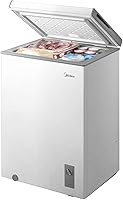
The Bodacious offers 5 cubic feet of storage with a 58-watt specification. Its cabinet measures 20.47 inches wide, 16.14 inches deep and 31.69 inches high, before allowing room for ventilation and lid access.
It suits a smaller household adding frozen vegetables, meal portions and occasional bulk buys. Bodacious claims operation below 40 dB, making it worth considering where appliance noise matters.
Skip it if large meat orders or bulky containers dominate your shopping. Measure your usual packages as well as the floor space, since total capacity doesn't guarantee that every awkward item fits.
Bodacious gives conflicting warranty terms of 15 months and 2 years. Confirm the applicable coverage before ordering if warranty length affects your choice.
BLACK+DECKER: for larger household reserves
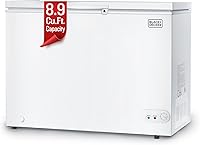
The BLACK+DECKER provides 10 cubic feet of storage and a 72-watt specification. It suits households that need room for bulk meat, batch cooking and a larger reserve of frozen food.
Its removable basket keeps small items within reach, while external controls let you adjust the setting without opening the lid. Manual defrost and an accessible drain mean you need to plan periodic frost removal.
The cabinet measures 40.7 inches wide, 29.5 inches deep and 33.5 inches high. Skip it if that footprint crowds your walking space or you won't use the extra storage.
Choose a kitchen or temperature-controlled basement for the intended indoor placement described here. For any garage installation, confirm the model's permitted ambient temperatures; the larger cabinet alone doesn't guarantee garage suitability.
Neither freezer's wattage figure proves lower annual consumption than the other. For broader comparison advice, see ENERGY STAR's freezer guidance.
Which plug-in meter should you choose?
Choose P3 for cost forecasting or MECHEER for a backlit display and more measurement views. Before buying either meter, confirm that it supports your freezer's electrical requirements and compressor load.
P3 Kill A Watt EZ: for tracking energy costs
The P3 records accumulated kWh and can forecast costs by week, month and year after you enter your utility rate. Its memory retains accumulated information through a power interruption.
P3 states accuracy within 0.2%. Its large LCD suits readers who want to record consumption and translate it into an ongoing energy budget.
Choose it if cost projections are your main goal. Skip a plug-in meter altogether if the freezer's connection or load falls outside the meter's limits.
MECHEER: for readings in a dim utility area
The MECHEER displays watts, kWh, volts, amps, frequency, power factor and other readings across seven modes. Its adjustable backlight helps when the outlet sits in a dim corner.
It also retains consumption data after unplugging or a power failure. That helps preserve a record, but you still need to note the measurement period yourself.
Choose it if display visibility and electrical measurements matter more than P3's forecasting features. Don't treat its adjustable overload warning as permission to exceed the meter's limits or as a replacement for circuit protection.
How should you measure your freezer's energy use?
Record accumulated kWh over several normal days, then divide by elapsed days. A momentary watt reading can't capture the freezer's full cooling cycle.
- Check compatibility. Read both manuals for voltage, current, grounding and compressor-use requirements before connecting the meter.
- Use the intended outlet. Keep the connection accessible and avoid stretching the freezer cord or improvising an adapter.
- Record a starting point. Note the meter's kWh total and the time, or reset its accumulated counter as directed.
- Use the freezer normally. Record major food additions, unusual lid use and room temperature changes.
- Calculate a daily average. Subtract the starting kWh from the ending total, then divide by the number of days.
For example, 2.4 kWh over 3 days equals 0.8 kWh per day. Keep initial cooldown separate if your goal is normal ongoing consumption.
After a move or a major seasonal temperature change, measure again. A winter basement reading won't describe the same freezer's summer garage use.
Which mistakes make power comparisons misleading?
The biggest mistakes are mixing units and comparing different conditions. Use the same measure and a similar storage job before drawing a conclusion.
- Multiplying rated watts by 24. This assumes uninterrupted draw at that level.
- Comparing watts with annual kWh. One describes power; the other describes energy over time.
- Treating volts × amps as exact watts. For an AC motor, that calculation gives volt-amperes; power factor affects real watts.
- Judging a freezer during initial cooldown. A newly started or heavily loaded freezer needs extra cooling.
- Buying a new freezer from one high reading. Check temperature settings, seals, frost and room conditions first.
Power use can help assess an older appliance, but it isn't a lifespan forecast. How long chest freezers last covers the wider replacement decision.
What setup and care help control energy use?
Correct placement, a sound lid seal and sensible temperature settings help limit unnecessary compressor work. Follow the freezer manual's clearance and ambient-temperature requirements rather than using a universal spacing rule.
Level the cabinet as directed and leave room for the lid to open fully. Keep heat sources away and don't block ventilation with boxes or storage bins.
Use a thermometer to verify the food-storage temperature instead of turning the dial colder by habit. See what temperature a deep freezer should be and our deep freezer thermometers and alarms guide.
Group food so you can find it quickly, and avoid exceeding the manual's freezing capacity when adding fresh food. Large warm loads can keep the compressor running longer.
Remove frost according to the manual, using how to defrost a chest freezer for a practical plan. Keep the gasket clean and check that packages aren't stopping the lid from closing; how to clean a deep freezer covers that care.
Deep freezer wattage: what should you choose?
Choose the freezer for your food and space, then compare kWh for running costs. Pick Bodacious for a smaller storage reserve, or BLACK+DECKER when you need the larger cabinet and can accommodate it.
For an existing freezer, choose P3 for cost forecasts or MECHEER for backlit readings. Measure normal use before deciding whether its energy demand justifies replacement.
If cabinet style is still undecided, read chest freezer vs upright power use and the wider chest freezer vs upright freezer comparison. For an unconditioned location, use the garage ready chest freezers guide before choosing a model.
Frequently asked questions
How many watts does a deep freezer use?
Wattage varies by model: the Bodacious freezer here has a 58-watt figure, while the BLACK+DECKER has a 72-watt figure; these numbers don't guarantee startup demand or daily energy use. For an existing freezer, measure watts during operation and record kilowatt-hours across several days.
Is wattage the same as kilowatt-hours?
No, watts measure power draw at a moment, while kilowatt-hours measure energy used over time. A freezer drawing 100 watts for a total of 10 hours uses 1 kilowatt-hour; that is an illustrative calculation, not a consumption figure for either freezer in this guide.
Why doesn't the wattage on the label match my meter?
A meter reading can differ because the compressor cycles, startup demand is brief, and operating conditions change. Check whether you're comparing instantaneous watts, average watts or accumulated kilowatt-hours; a single watt reading and a full day's energy total describe different things and shouldn't match numerically.
What plug-in meters can measure a deep freezer?
The P3 Kill A Watt EZ records kilowatt-hours and projects energy costs, while the MECHEER meter displays watts, kilowatt-hours and other electrical measurements. Before connecting either one, confirm that its voltage, current and appliance-use limits suit your exact freezer, including compressor startup requirements.
Do all deep freezers list wattage?
No, some freezer information gives voltage and current, while other information gives daily or annual energy use. Ask the manufacturer if you need a specific operating or startup figure; for running costs, compare annual kilowatt-hours under comparable conditions or measure your freezer over several normal days.