How to Choose a Chest Freezer for a Hot or Cold Garage
Choose a chest freezer for garage use whose approved operating range covers the air temperatures around it. Then match capacity to your food, measure lid clearance and add an independent thermometer.
On this page (11 sections)
- Measure the conditions your chest freezer for garage use must handle
- Match the operating range before comparing capacity
- Choose capacity around the food you actually keep
- Which freezer suits your garage and shopping habits?
- Measure the delivery route and the fully open lid
- Set up the freezer where it can shed heat
- Use a thermometer and make sure alerts reach you
- Organize food so the freezer stays useful
- Plan for frost, seasonal extremes and power loss
- Avoid the mistakes that undermine a garage installation
- Choose the chest freezer for garage conditions you can support
Choose a chest freezer for garage use by matching its approved operating range to your garage's hottest and coldest conditions. Capacity comes next, because extra storage won't help if the freezer can't run properly where you put it.
The Midea 7 cu ft is the clearest starting point here for an unheated garage because it has stated ambient limits. Frigidaire and Hamilton Beach offer garage-ready models, while the BLACK+DECKER needs closer placement checks.
Keep 2 temperatures separate throughout the decision: garage air temperature determines installation suitability, and food compartment temperature tells you whether the freezer is cold enough.
Measure the conditions your chest freezer for garage use must handle
Measure the air where the freezer will stand, including seasonal extremes. A mild afternoon reading won't tell you what happens beside a closed garage door during a heat wave.
Use a thermometer with minimum and maximum memory, or a logger that records throughout the day. Place it near the planned cabinet position, away from direct sun and hot exhaust air.
Collect readings during hot and cold weather when possible. A week of mild weather is only a starting point, so consider past extremes before committing to a model.
An attached garage, detached garage and heated workshop can have very different conditions. Insulation slows temperature changes, but it doesn't guarantee that an unheated room stays warm through winter.
Chest freezer for garage use: ambient limits versus storage temperature
An ambient operating range describes the air outside the freezer. It isn't the temperature you should set inside the food compartment.
For example, garage air at 18 F and 104 F falls within Midea's freezer-mode limits, though the hotter reading leaves little room for worse weather. That doesn't mean food should be stored anywhere near those garage temperatures.
USDA FSIS recommends keeping a freezer at 0 F or below in its freezing and food safety guidance. Use an independent thermometer to check that target rather than guessing from a thermostat dial.
Match the operating range before comparing capacity
Choose a model whose approved ambient limits cover your expected conditions. If the garage falls outside them, choose another freezer or another location.
The meaning of garage-ready on a chest freezer is useful background, but the exact model's limits matter more than the label.
Midea specifies 0 F to 110 F in freezer mode and 38 F to 110 F in fridge mode for its 7 cu ft convertible. Switching modes changes the approved conditions, so a location suitable for frozen food may be too cold for refrigerator use.
Frigidaire calls its EFRF5003 garage-ready, and Hamilton Beach uses the same description for its HZ9471. Their exact ambient limits aren't provided here, so get those from the brand before choosing either for severe heat or cold.
BLACK+DECKER describes its model for a kitchen or temperature-controlled basement. That supports considering it for stable indoor conditions, but doesn't guarantee approval for an unheated garage.
Don't assume that leaving extra ventilation space extends an approved temperature range. Clearance helps the freezer shed heat; it doesn't change its operating limits.
Choose capacity around the food you actually keep
Buy enough room for your normal food load and your largest planned restock. Occasional overflow from a refrigerator freezer needs less space than bulk meat orders and a season of garden produce.
Picture the packages you'll store, including tall containers, wide pizza boxes and large cuts of meat. A cabinet can have enough total volume yet still be awkward for the shapes you buy.
Use these as starting points:
- 5 cu ft: extra meals, vegetables and smaller grocery restocks.
- 7 cu ft: more room for family meal prep or mixed frozen groceries.
- 10 cu ft: larger batch-cooking sessions and bulk food loads.
- 17 cu ft: substantial reserves that need a deliberate stock rotation system.
Choose for access as well as volume. If you can't comfortably reach the bottom, smaller grouped containers can help, but a different cabinet size may be the better choice.
Avoid buying a large freezer simply because a wall is empty. Food that gets buried and forgotten uses storage space without helping your household.
Which freezer suits your garage and shopping habits?
The best choice depends on your climate, storage load and available space. These models serve different buyers, and the largest one isn't automatically the most useful.
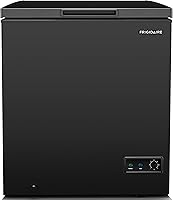
Frigidaire EFRF5003: for a small second freezer
Choose the Frigidaire 5 cu ft for modest overflow storage once its approved ambient limits match your garage. It suits someone who wants to move frozen meals, vegetables and smaller meat packs out of a crowded refrigerator freezer.
Its removable vinyl-coated wire basket gives small items a place near the top. The exterior defrost drain helps with cleanup, while the power indicator shows that the unit has power rather than confirming food temperature.
Skip it if your regular restock already fills several large containers or includes bulky food packages. The Frigidaire EFRF5003 review covers this model in more detail.
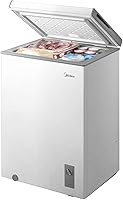
Midea 7 cu ft: for seasonal flexibility
Choose the Midea convertible if you need frozen storage now and may want refrigerator space later. The separate operating ranges make it easier to judge suitability for a garage that changes with the seasons.
It has a removable plastic basket, adjustable legs and an LED light. The light is useful in a dim garage, while the basket keeps smaller packages from disappearing beneath larger food.
Skip it if you need chilled drinks and frozen food at the same time. Conversion changes the cabinet's role; it doesn't create separate refrigerator and freezer compartments.
Midea claims up to 48 hours of frozen storage after power loss. Treat that as a brand claim, and judge food after an outage by temperature and condition rather than elapsed time alone.
BLACK+DECKER 10 cu ft: for larger loads in stable conditions
Consider the BLACK+DECKER when you need more storage and have a temperature-controlled location. Confirm approval for your garage before choosing it, since the stated placement guidance names a kitchen or temperature-controlled basement.
Its exterior mechanical dial and power and compressor lights let you check controls without lifting the lid. A removable basket and manual-defrost drain support basic organization and care.
Use temperature control as a starting condition, then confirm the exact installation with BLACK+DECKER. Skip this model for an unheated garage unless the brand supplies operating limits that cover it.
Hamilton Beach 17 cu ft: for substantial food reserves
Choose the Hamilton Beach for large food loads after confirming both its ambient limits and your access route. It makes more sense for planned bulk storage than for occasional overflow.
The stay-open lid helps while you sort packages, and the removable wire basket keeps smaller items within reach. Its front-access defrost drain gives you a place to manage meltwater during maintenance.
Skip it if you can't keep a clear aisle or regularly rotate stored food. The large chest freezers guide helps compare this size with other large cabinets.
Measure the delivery route and the fully open lid
Measure the cabinet position, delivery route and lid opening before ordering. The closed dimensions don't include ventilation gaps or the space needed to stand and reach inside.
| Model | Width | Depth | Closed height | Weight |
|---|---|---|---|---|
| Frigidaire EFRF5003 | 28 in | 23 in | 35 in | 35 lb |
| Midea 7 cu ft | 30.3 in | 22 in | 33.5 in | 65.3 lb |
| BLACK+DECKER 10 cu ft | 40.7 in | 29.5 in | 33.5 in | 99.2 lb |
| Hamilton Beach 17 cu ft | 70 in | 28 in | 35.04 in | 168 lb |
Check doorways, turns, steps and thresholds along the entire route. Arrange help and suitable moving equipment rather than deciding how to lift the cabinet when it arrives.
Look above the planned position for shelves, garage door tracks and handles. You need enough room to open the lid fully and lift a loaded basket without hitting anything.
Keep the freezer clear of vehicle paths and stored equipment. A spot that works with the car outside may become unusable when the garage is full.
Set up the freezer where it can shed heat
Use a dry, level location with the ventilation clearances required by the manual. Keep direct sunlight and nearby heat sources off the cabinet.
Don't press a flat-back cabinet against a wall unless its instructions allow that spacing. Also leave access to the controls, plug and drain so routine checks don't require moving a loaded freezer.
The guide to putting a chest freezer in the garage covers placement decisions. If the planned spot is exposed to rain or outdoor weather, read whether a chest freezer can stay outside before going further.
Follow the manual's electrical requirements and plug directly into a suitable grounded outlet. Have an electrician assess a questionable outlet rather than relying on an extension cord.
After delivery, follow the model's instructions for standing time and startup. Let the empty cabinet reach its storage temperature before loading food, and avoid adding a large batch of warm food at once.
Use a thermometer and make sure alerts reach you
Use an independent thermometer inside the freezer, with an alarm if you want warnings between checks. A power light confirms power at the unit, but it can't tell you that food remains cold enough.
MOCREO's kit includes an H5Pro hub and 2 LS1 sensors. The sensors cover -4 F to 131 F, with stated accuracy of ±0.9 F, so they cover normal freezer storage but can't measure temperatures below their lower limit.
The hub connects through Ethernet or 2.4 GHz Wi-Fi and offers app notifications, email alerts and a 95 dB beep. MOCREO's open-air range claim doesn't predict performance through your garage walls and freezer cabinet.
MOCREO warns that enclosed metal spaces can interfere with the signal. Check reception with the lid closed, then verify that notifications reach your phone before relying on remote warnings.
The sensors' IP66 protection is useful around splashes, but doesn't mean they should be submerged. Also, MOCREO's battery-life claim of up to 2 years applies above 32 F, so don't assume the same life inside a freezer.
Skip this kit if you only need a local reading and don't want a connected hub. See the deep freezer thermometer and alarm options for alternatives.
Organize food so the freezer stays useful
Group food by type, label packages with dates and keep frequently used items near the top. A simple inventory helps you shop from existing food before adding more.
Use the included basket for small packets and items that otherwise slip into gaps. In a larger cabinet, separate meat, prepared meals and vegetables into manageable groups rather than making one deep pile.
Choose containers you can lift comfortably when full. The chest freezer organization guide explains how to build a system around the food you store.
Don't block the lid seal with bags or stack food so high that the lid needs pressure to close. Keep a small clear sorting area nearby so you can find packages without leaving the freezer open for long periods.
Plan for frost, seasonal extremes and power loss
Check the interior temperature, seal and frost buildup throughout the year. A freezer that works well in spring still needs attention during its first hot summer and cold winter.
During extreme weather, watch both garage air and food compartment readings. If the garage exceeds the approved limits, arrange an approved location rather than turning the thermostat colder and hoping that solves the problem.
Keep the lid closed during an outage and use temperature information to guide food decisions afterward. Remote notifications may also be affected by lost power or internet service, so understand what your alert system can still do.
Defrost according to the manual, with food moved to suitable cold storage first. Protect the floor from meltwater and never chip ice with a sharp tool that could damage the cabinet.
Dry the interior before restarting and check that the drain is closed correctly. The chest freezer defrosting guide walks through the care steps.
Avoid the mistakes that undermine a garage installation
The main mistakes are choosing by label alone and confusing garage conditions with food temperature. Keep both checks visible in your buying and care routine.
- Using a mild-weather reading: allow for seasonal extremes, not just delivery-day weather.
- Assuming every mode has the same limits: a convertible freezer can have different refrigerator requirements.
- Treating dial numbers as degrees: confirm storage temperature with a thermometer.
- Filling required ventilation gaps: keep boxes and tools out of those spaces.
- Blocking access with parked vehicles: preserve room to open the lid and reach the plug.
- Trusting an unverified wireless signal: check reception and alerts with the cabinet closed.
- Oversizing without a storage plan: choose capacity you can organize and rotate.
The comparison of garage-ready and regular chest freezers explains the operating distinction. For a broader shortlist, see the best chest freezers for the garage.
Choose the chest freezer for garage conditions you can support
Choose the Midea when its operating limits cover your garage and convertible storage meets your needs. Choose the smaller Frigidaire or larger Hamilton Beach after the brand confirms suitable ambient limits.
Consider the BLACK+DECKER for a stable, temperature-controlled location once the brand approves your garage installation. Add the MOCREO if remote alerts are useful and its sensor range and connection work in your setup.
Before ordering any chest freezer for garage use, you should have 3 things: a suitable operating range, measured installation space and a plan to check food temperature. If any is unresolved, settle it before arranging delivery.
Use the garage-ready chest freezers complete guide for the next step in narrowing your choice.
Frequently asked questions
What temperature range should a garage freezer have?
Its approved ambient range should cover the coldest and hottest air around the cabinet. Midea gives this model a freezer-mode range of 0 F to 110 F, but fridge mode has a different lower limit; measure garage conditions across seasons and confirm the range for the exact model and mode.
Can a chest freezer go in a garage that gets very hot?
Yes, if the exact model's approved ambient range covers the heat and you can meet its installation requirements. Keep it shaded, leave the ventilation gaps required by its manual and monitor the food compartment separately; a garage-ready label doesn't approve operation above the model's upper temperature limit.
Do I need a thermometer if the freezer has a dial?
Yes, use an independent thermometer because a numbered dial sets cooling without showing the actual storage temperature. Aim for 0 F or below inside the freezer; an alarm can warn of warming between checks, but its sensor range and wireless connection must suit the cabinet and garage.
Is a garage-ready name enough to trust?
No, confirm the approved ambient range for the exact model before using it in an unheated or very hot garage. Frigidaire and Hamilton Beach call these models garage-ready, but their operating limits aren't provided here; ask the brand for those limits and compare them with your seasonal readings.
Which freezer here suits a temperature-controlled garage?
The BLACK+DECKER 10 cu ft is worth considering for a temperature-controlled garage after you confirm the installation is approved. Its stated uses include a kitchen or temperature-controlled basement, which doesn't guarantee garage approval by itself; choose it for larger food loads only if its dimensions and access needs also fit.